
Metis™
Predictive Hormone Variability Engine
The first computational engine that creates a personalized hormonal digital twin — transforming how we understand, predict, and respond to hormonal variability across the lifespan.
Why Metis Exists
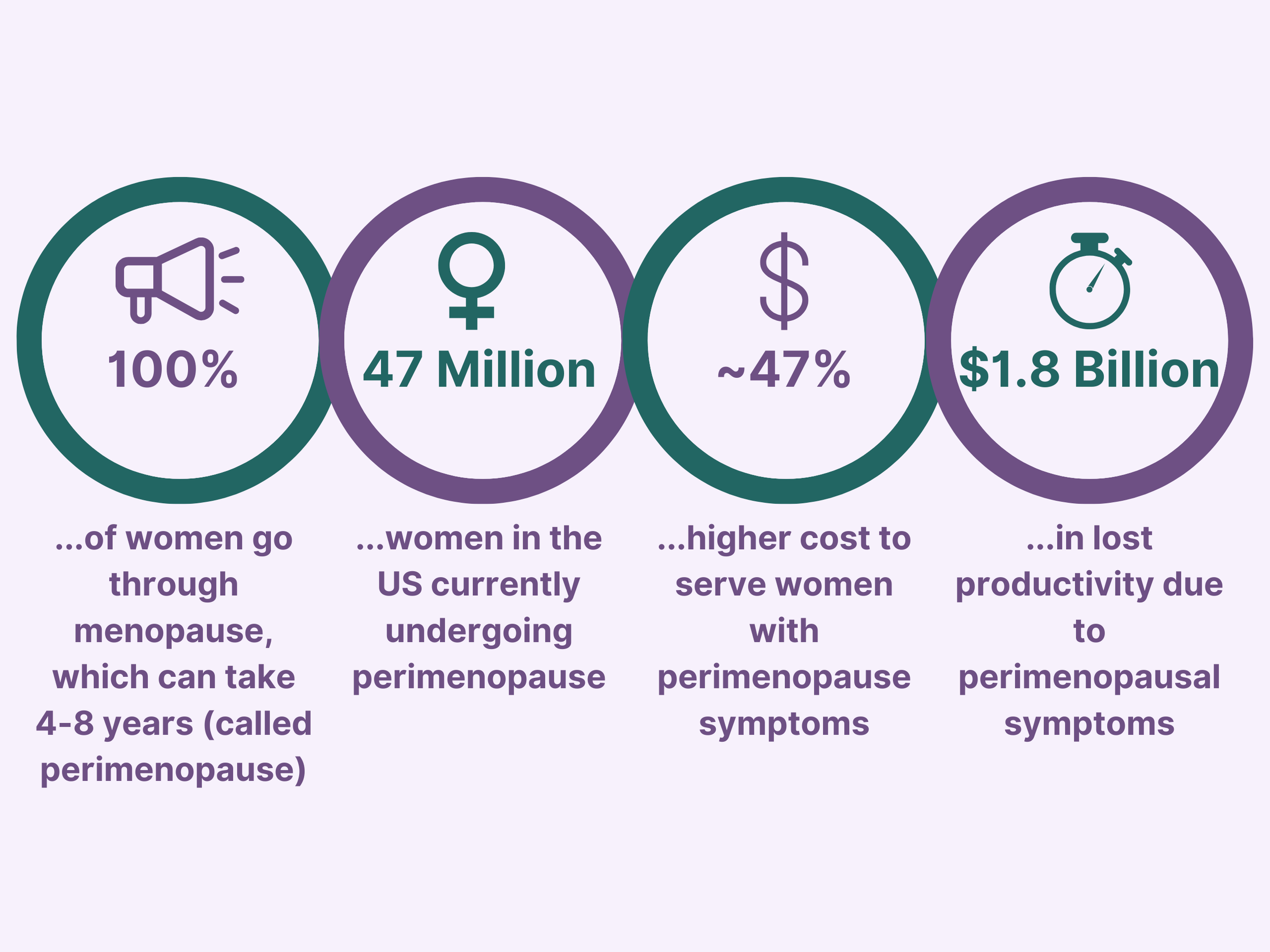
Hormonal variability is a universal health challenge — but for women in perimenopause, it becomes a crisis. During the perimenopausal transition (typically ages 40–55), the endocrine system becomes non-stationary: hormone levels fluctuate unpredictably, cycles swing from 21 to 90+ days,
Current tools fail because they were designed for stable biology. Period tracking apps assume regular cycles. Annual lab draws capture a single snapshot of a chaotic system. Population-average models cannot account for individual trajectory variation. No existing technology can predict where a woman is heading hormonally — only where she has been.
What Is Metis™?
Metis (Μήτις): Greek for “wise counsel, deep thought, adaptive wisdom.” In mythology, Metis was the Titan goddess of wisdom and the mother of Athena.
Metis is a patent-pending computational modeling engine that creates a personalized hormonal digital twin for each user. It fuses data from wearable devices, daily symptom logs, laboratory panels, electronic health records, voice biomarkers, and genomic profiles into a unified, continuously updating model of an individual’s endocrine system.
Rather than treating hormones as static lab values, Metis models them as the dynamic, non-stationary system they actually are. It borrows proven mathematical frameworks from fields that have already solved analogous problems: signal processing from telecommunications, regime-switching models from quantitative finance, ensemble forecasting from meteorology, and digital twin technology from aerospace engineering.
The result: for the first time, it becomes possible to predict where someone is heading hormonally — not just where they’ve been.
“We’re not building a period tracker. We’re building the scientific proof that the female hormone cycle is a vital sign in healthcare.”
— Rangena Hotaki, Founder & CEO
Six Data Streams, One Unified Model
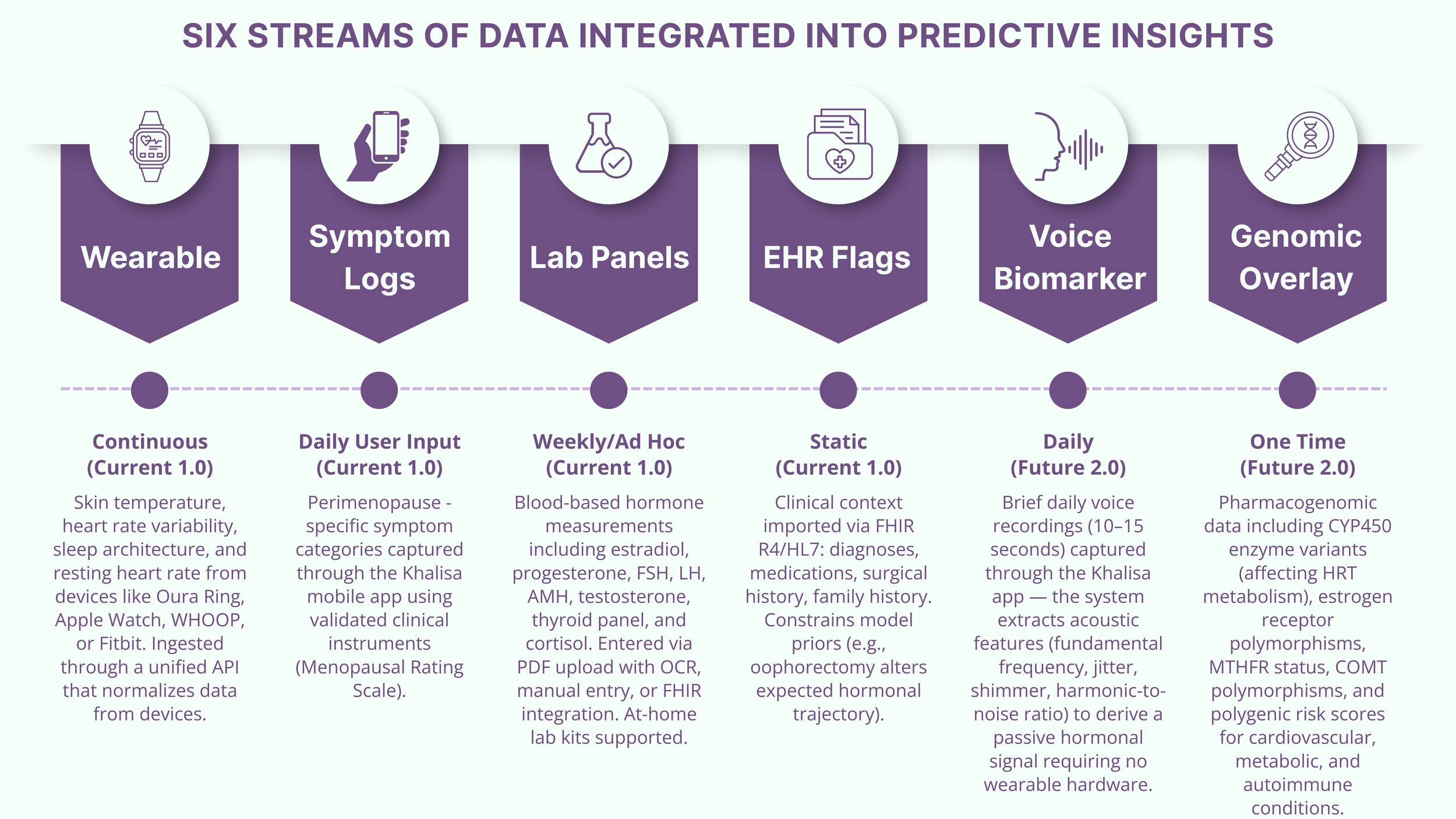
Most health applications rely on a single data source. Metis fuses six streams operating at fundamentally different temporal resolutions — from continuous wearable data to one-time genomic profiles — into a unified probabilistic estimate of the user’s hormonal state.
What Makes Metis Different
Real-time multi-modal data fusion
No existing system fuses continuous wearable data, daily symptoms, periodic labs, static EHR records, voice biomarkers, and genomic profiles into a single probabilistic model.
Regime classification, not cycle phase detection
Metis identifies which life stage you’re in — not which day of the cycle. This is the distinction between knowing you’re in perimenopause versus knowing it’s day 14.
Probabilistic output, not false precision
Metis produces calibrated probability distributions: “60% chance your next period starts between days 26–32, 20% chance of extension to day 40+.” It’s honest about uncertainty.
Per-user personalization via digital twin
No two women follow the same hormonal trajectory. Metis creates a computational replica of each individual that diverges from population averages as her data accumulates.
Domain-generalized architecture
The same four-layer mathematical framework works across perimenopause, male hormonal health, thyroid, adrenal, and metabolic applications. Only the parameters change.
Clinical-outcome design, not engagement design
Metis is built for clinical decision support and anticipatory treatment — not for daily engagement metrics. It feeds directly into the downstream titration system (patent pending) for cycle-aware medication dosing.
One Architecture. Five Endocrine Domains.
Perimenopause is the primary embodiment and clinical focus — but the underlying mathematical architecture is domain-agnostic. The same Kalman filter, HMM, particle filter, and digital twin pipeline operates identically whether applied to female reproductive, male hormonal, thyroid, adrenal, or metabolic systems. Only the input data streams, regime definitions, and model parameters are domain-specific.
This generalizability is not aspirational — it is architecturally built in. The patent specification defines HMM state sets for each domain: 5 reproductive lifecycle states, 4 andropause progression states, 5 thyroid function states, 4 adrenal regulation states, and 4 metabolic regime states.
Built for Clinicians, Researchers, and the Women They Serve
For Clinicians
Regime classification with confidence levels. Predictive forecasts 1–3 months ahead. Cycle-aware dosing (feeds into US 63/954,175). Disease pathway alerts (cardiovascular, metabolic, neurological, bone density).
For Researchers
Multi-modal fusion dataset. Sex-disaggregated analytics. Digital twin simulations for interventions. Training datasets: SWAN (3,302 women), NHANES, BioCycle, mcPHASES, MsFLASH.
For Partners & Grant Makers
Patent-pending technology (two provisional patents). $22B+ addressable market (perimenopause, menopause, postpartum, puberty). Grant-funded pathway: NIH SBIR/STTR, NSF SBIR, ARPA-H, AHRQ. Downstream integration: powers Khalisa™ consumer mobile app.
When women are well, families, communities, and society thrive.
We’re seeking clinical, technology, and research partners to bring Metis from concept to clinical impact.